Djayesse
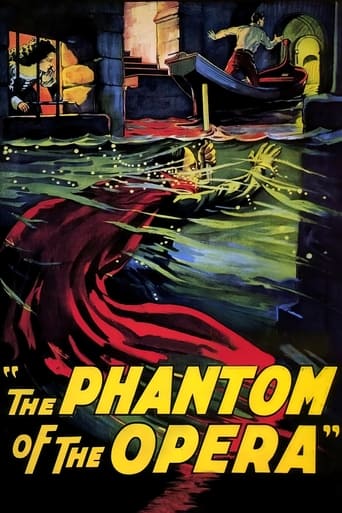
Lon Chaney was "the Man with the thousand faces". Nevertheless, in this film, we have to wait for forty-five minutes before being able to see his made-up face. Before that, he wears a mask. But it was worth waiting. We have rarely seen such a hideous face. There is ugliness, wickedness, but also despair in this face. This hideous face shows the hideous but tortured soul inside. As we do not always see his face, Lon Chaney uses his hands a lot. These are very expressive and help very much in the story. What about the story? There is a curse which struck the Opera Garnier in Paris. A ghost rules it. This ghost had the diva Carlotta (Mary Fabian) replaced by a young singer: Christine Daaé (Mary Philbin). But since she has been promoted, Mary Daaé has troubles with the Phantom. She has to love him. But she cannot, she loves another man: Raoul de Chagny (Norman Kerry).Once again, Lon Chaney plays a frustrated lover. Erik (the Phantom's name) - and later Alonzo in The Unknown (Tod Browning, 1927) - loves but is not loved back. And when Christine takes off his mask, we understand why. (Her disgust is certainly not faked: in an effort to give us a true effect of Mary's surprise - and disgust -, she discovered his face at this very moment!) One has to say that this face is quite disturbing: it is said that a few spectators fainted when they saw his face. The use of color is also very important in this film. A few filters are used - like in other movies: blue for the night, yellow for the sun... - but here, the ball scene was entirely shot in real colors. And thanks to the work of the great Kevin Brownlow (his name be praised!), we can now see a very good copy of this film and enjoy ninety-four minutes of Lon Chaney: no more fog, nor blur, nor any sign of film deterioration. And the shadows... Sometimes, we could think we are in a 1920s German movie. At first, the Phantom himself (itself?) is a shadow in a dark setting. And this shadow is scary enough to make the dancers flee with fear. We do not know if he really exists. This is one of Lon Chaney's most significant roles. You cannot forget Erik, this evil angel, who is a sort of Mephisto's doppelganger in the Faust which is played in the Opera. Lon Chaney - just like in The Penalty - suffered a lot for this character: his nose bled and he used rubbers and small hooks to create this distorted face. But Chaney will be Chaney! Despite his appearance, Erik is not a ghost. He is very human: he is in love. A desperate lover. Everything in his attitude shows his despair. First, he thinks Christine loves him for what he has done to her. But then he discovers it is not true. She tells him she loves him - to save Raoul - but he realizes it is nothing but a lie. So he has nothing to lose anymore. And his final scene - the only possibility left for such an insane character - is full of despair. And his last laughter rings us a last bell: "Humour is the politeness of despair."
Matreats :P
Reaching over $2,000,000 in total gross, the 1925 version of "The Phantom of the Opera", was indeed one of the most famous movies of the time. With famous actors like Lon Chaney and Mary Philibin, and unforgettable characters, "The Phantom of the Opera" is definitely a film worth seeing.A mysterious Phantom is said to have haunted the Paris Opera house for years, and when a group of ballet dancers sees his shadow, the rumors spread like wildfire. The Phantom is actually a man who falls in love with a certain young lady named Christine Daae, and goes to extreme extents to get her to love him, despite his ugly appearance.My first impression of the movie was a little hesitant, because I have seen the Broadway production of this movie before, and didn't know if I would compare the two; but as the film progressed, I was impressed. The acting made the story line very clear, and though it was dramatic at times, it helped progress the plot and show the character's emotions and feelings. Also, the way the characters developed over the course of the film was well thought out and easy to follow.Throughout the duration of the movie, you had to pay close attention because of the title cards. Because it's a silent film, the title cards are completely necessary and critical to the development of the story. They also made you more involved in the story, because you have to keep your focus on the movie or else you could miss an important piece of dialogue. The actual story of the film was very entertaining, and included things like complex characters and an actual plot. I noticed that the way they use scene changes is very similar to what we do now; leaving one scene and going to another to create suspense and show what the other characters are doing while something is going on elsewhere. The lighting was significant in this movie, especially with a character like the Phantom. They used and played with shadows to add to the tension and mysteriousness of the character and his actions, like during the scene where some of the men find the man who told stories of the Phantom hung backstage. Though it was only a silhouette of the figure, the idea still came across, and it left an idea for the audience to envision. Because of how old the film was, however, there were some places where the lighting made it hard to see; whether it was too dark to make out what was happening, or so bright the characters faces were hardly visible. Fortunately, it didn't happen often. My favorite part of the entire film had to be the music; it set the mood for each scene, playing light-hearted music during the love scenes, and suspenseful music during the scenes involving the Phantom. Though you don't really notice it very much if you don't focus on it, the music playing in the background evokes emotion from you that you wouldn't have felt otherwise. The music combined with the story line helped build up the plot and the conflict right until the end of the movie, where the final scene and climax takes place.Shortly after I finished the film, I did some research and figured out that they didn't use an actual opera house to film the movie inside. They built a replica of the Paris Opera house, which took them a year to build. They hired sculptors and designers to create the statues and the grand staircase shown in the masquerade scene. They also built the massive chandelier, which weighed 16,000 pounds, and was forty feet across. The amount of work and money put into creating this movie is quite amazing, including the makeup that Lon Chaney did to accurately portray the character of the Phantom.I enjoyed watching this film, and taking a step out of my regular "modern movie" comfort zone. I would rate it at 8 stars, and would definitely recommend it to people who haven't seen it before.
De_Sam
While already present in 'Annabelle's serpentine dance' by WIlliam Dickson, many early filmmakers have striven to be the first to integrate colour in their films.It can be debated if Rupert Julian is truly the director of the version I saw as he left the film when the studios told him to reshoot large parts of the film, after him in order, Edward Sedgewick, and Maurice Pivar and Lois Weber tempered with the original. If I were to contribute the technical choices of this film, I would not not to which one.Whoever it was, he uses many filters to differentiate the mood of each location in the film, but for the key scene in which the phantom appears as "Red Death", the film is in 'colour', as the costumes of the participants of the masked ball are presented in hues of red and green. Personally, it did not contribute greatly to the viewing experience.The narrative of the film relies heavily on intercut text, which was annoying in the more dialogue-heavy scenes.I had to fortune to see this on a cinema screen, accompanied with live piano music that elevated my enjoyment. But in all, I think the tumultuous production process can be felt when viewing the film, and I cannot help but wonder what it could have been, less crippled to suit the taste of the masses.
Dalbert Pringle
Favorite Quote - "His eyes are ghastly beads in which there is no light - Like holes in a grinning skull!" Released in 1925 - With Lon Chaney's compelling performance, as "The Phantom", being one of this picture's strongest assets, here is a production (filmed on a grand scale) that I'd say was one of the most civilized and cultured horror movies of all time.Set in and around the magnificent Paris Opera House (in Paris, France, of course), this tragic story of obsession, revenge and unrequited love is both a finely-tuned and nicely-paced tale that holds the viewer's rapt attention right from its eerie and intriguing opening, to its climatic finish with the angry mob in hot pursuit of "The Phantom", who is fleeing for his life.This is a film that is certainly not short on riveting drama.Besides the scene where "The Phantom" brings down the massive chandelier onto the heads of the opera-house's audience - The scene where Christine Daae tears away "The Phantom's" mask to reveal the hideous ugliness below, has got to be one of the most shocking moments in horror-movie history.Now 90 years old, I highly recommend this film to anyone who enjoys a genuine scare in the good, old-fashioned way, sans guts-n-gore.



 AD