On Dangerous Ground

On Dangerous Ground

1951 "In One Strange Night she met both LOVE... and MURDER!"
On Dangerous Ground
On Dangerous Ground

On Dangerous Ground

7.2 | 1h22m | NR | en | Drama

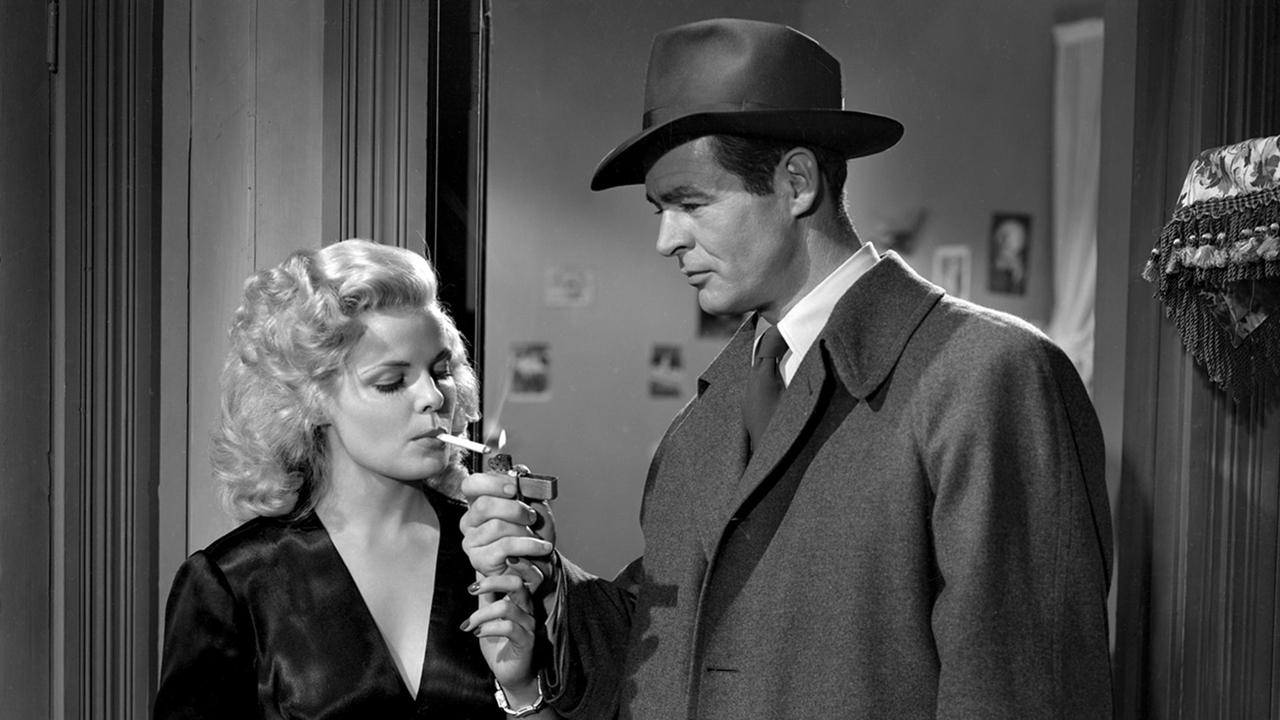
A big-city cop is reassigned to the country after his superiors find him too angry to be an effective policeman. While on his temporary assignment he assists in a manhunt of a suspected murderer.

View More
Rent / Buy
amazon
Buy from $14.99
AD

WATCH FREEFOR 30 DAYS

All Prime Video
Cancel anytime

Watch Now
7.2 | 1h22m | NR | en | Drama , Crime | More Info
Released: December. 13,1951 | Released Producted By: RKO Radio Pictures , Country: Budget: 0 Revenue: 0 Official Website:
Synopsis

A big-city cop is reassigned to the country after his superiors find him too angry to be an effective policeman. While on his temporary assignment he assists in a manhunt of a suspected murderer.

...... View More
Stream Online

The movie is currently not available onine

Cast

Ida Lupino , Robert Ryan , Ward Bond

Director

Albert S. D'Agostino

Producted By

RKO Radio Pictures ,

AD

Watch Free for 30 Days

All Prime Video Movies and TV Shows. Cancel anytime.

Watch Now

Trailers & Images

Reviews

Leofwine_draca A solid, character-driven film noir with some great location photography, ON DANGEROUS GROUND proves to be a fitting addition to an overloaded genre. This is a film of two halves, starting out as a typically tough, two-fisted detective story about a cop with a penchant for violence (played well by Robert Ryan). Around the halfway mark, the action shifts to the icy, wintry, countryside (shades of both FARGO and INSOMNIA here) and the pursuit of a killer.ON DANGEROUS GROUND is blessed with a decent script and some solid performances from both Ryan as the incredibly tough lead and Ida Lupino as the blind woman who might well hold the secret to the killer's identity. Lupino is on particularly strong form here, putting across her character's fragility mixed with a particular toughness all of her own. The cinematography is very good, with some great chases in the snow, and Bernard Herrmann's score only adds to the experience.
dougdoepke I still see those dark figures outlined against a bleak sky and snowy terrain, Ryan in his improbable city clothes and hat, plus Bond in his outdoor hunting gear. Only it's not deer they're chasing. Instead, the boy is climbing ever higher and higher above them. But that's only one arresting visual in a film full of gripping visuals, and taut emotions. In my 60-some years of movie addiction, this is one of the most memorable and thought provoking. From jittery urban opening to serene pastoral close, it's perhaps the most moving tale of humane redemption I've seen.And who better to play hardened city cop Wilson than the great Robert Ryan. Those beady black eyes are unforgiving whether smacking around a closed mouth hooker (Moore) or thumping on a masochistic thug (Irving). Maybe he's just doing his job, then again, maybe he's come to enjoy it. Whichever, he's one tough cop who's in trouble with the higher-ups for his too often brutal methods. But then, all he sees, as he grimly observes, are cheaters, criminals and low-lifes. Worse, the people he theoretically protects use the word 'cop' like it was a curse word. So, who wouldn't encase himself in reptilian skin in order deal with that world. But unlike his cop partners, who return home to a wife and family, Wilson returns only to athletic trophies that have long since lost meaning. In short, he's thoroughly alienated from others, whether he realizes it or not.Those city street scenes are grippingly staged in true noir fashion, underscoring the twilight world Wilson inhabits. The way director Ray films complements Wilson's predicament perfectly. And when the camera cuts away from the violence, we are almost made to feel the agony that follows.Note how Ray and co. use the many road shots to advance the story. Once Wilson's sent north to 'Siberia' (Colorado) as punishment, he travels inwardly into a different world of snowy mountains and open spaces. Still, he carries the city and his job with him. Only now, his assignment is specific: help catch the killer of a young girl, now fleeing across the snowscapes. Too bad Brent (Bond), the dead girl's dad, is no help. He snarls out 'city cop' like it's a curse word, just what Wilson needs. On the trail, the suspect's tracks lead to a cabin in the snowy wilderness, where it seems a strange woman lives. Note the warm fireplace when they enter, a promising relief from the alienating outdoors.This is a part tailor made for the soulful Lupino as Mary (note the name), who's blind and lives with her brother. But he's gone visiting, so she says. Betraying his deeply buried sensitivity, Wilson soon discerns her handicap though she says nothing about it. The uncaring Brent, however, storms about the house, intent only on finding his daughter's killer. In fact, Wilson must now confront someone more intense than himself; in short, Brent amounts to a rural version of the brutal Wilson, the city cop. And so begins the process of sensitizing Wilson to his own excesses and the needs of others. Lupino manages to keep her blind girl part from becoming too sticky. Director Ray has positioned cues about the house that help Mary navigate the surroundings, like the hanging twigs she touches in the fireplace room. As a result, we get the impression she can take care of herself despite the handicap. Still, she must now deal with an enraged Brent and a purposeful Wilson who've suddenly invaded her little world.The hardened city cop is now in a dilemma. It looks like Mary is hiding her brother, who in fact is the killer. At the same time, he wants to protect her from the overbearing Brent. This amounts to a new role for him, one that he has perhaps never experienced. In a sense, he has begun to perceive Mary's predicament through her handicapped eyes instead of his own. For he himself has been blind to others in a figurative way. But now he's learning there are other ways of seeing besides the visual.That scene of Mary opening the cellar door at dawn is a powerful one. Danny (Williams), her brother, cringes in shadow while behind her shines the newborn sun. If only she could convince him to go with Wilson, Danny would be safe. It's a near-religious moment, religious in a good sense that doesn't exaggerate. And when Wilson throws away Brent's rifle before he can possibly shoot Danny, we know the bad cop has at last been left behind. Still, it's surprising that once the conflict with Danny is over, Mary doesn't just fall into Wilson's now caring arms. But she's had her own little world too long to share it with a relative stranger. So they part for their separate worlds. Mary, riddled with grief; Wilson grappling with the changes as he travels the road back to the city. But this is not the end.Apparently Ray disliked the actual ending, saying he didn't believe in miracles. But the ending is not just superbly touching, but also quite appropriate. For both Mary and the city cop have managed to overcome the isolated worlds they too long dwelt in. To me, the movie is one of the grittiest, most moving, tales of redemption I've been lucky enough to catch.The production amounts to a happy collaboration among Hollywood's most talented movie makers— from producer Houseman (what would the movie be like without the expense of those real Colorado mountains?), to director Ray (with him, you don't just see the screen images, you feel them), to composer Herrmann (this he says is his best score and that includes the many with Hitchcock), to, of course, the luminescent pairing of Lupino and Ryan.Anyway, my words are only words. If you haven't seen the movie, please do. I don't think you'll be disappointed.
classicsoncall Director Nicholas Ray had a penchant for themes of alienation and loneliness. With "On Dangerous Ground", he positions his principal players with conditions that isolate their loneliness in contrasting ways. Detective Jim Wilson (Robert Ryan) stands apart from his fellow officers by virtue of internalizing his job, creating in himself a distrust of all humanity. When he meets Mary Malden (Ida Lupino), he finds her to be isolated by her blindness, living alone with her mentally challenged brother in a remote small town some seventy miles north of the City.If this was going to be about simply catching the killer of an innocent young girl, it could have been handled in the first half of the film when we first see Ryan's character as the hard boiled and cynical street cop. He's still that same cop when he arrives in Westham, but over time a curious transformation takes place. There's a fleeting moment when the detective observes Walter Brent (Ward Bond) in a rage over his daughter's murder and vowing to blow the killer away. It doesn't last long, but in that brief moment Wilson sees himself with all the hatred and confusion that's built up inside himself after eleven years as a cop.Film noir fans will be engaged by the first half of the picture - gritty city nightscapes and tough cops scouring the streets for thugs and low-lifes. The bar scene exploits an underage trashy hooker who makes a pass at Ryan, and gets the old heave-ho in return. The noir feel is maintained to a degree in the latter half, as much of the story takes place in Lupino's darkened home. Then the chase for Mary Malden's brother occurs over a snow covered landscape in sharp contrast to typical noir sensibility.I don't know if I'm buying the resolution to the story all that readily. Mary didn't seem all that distraught that her brother died, especially after Wilson vowed his help in securing his safety. And I'm not convinced that Wilson would have turned his entire life on a dime to return to Mary and give up the big city life. But oh, that closing moment, that's what stays with you as Jim and Mary embrace in a happy ending that defies all probabilities. Ryan and Lupino have a way of making it look credible.
Ilpo Hirvonen Film-noir was a common genre for Nicholas Ray and he had directed several of them, one of which is Humphrey Bogart's career's highlights, In a Lonely Place (1950). Ray is best known for the James Dean classic Rebel without a Cause and the ones familiar with his early film-noirs can see the continuity of noir in it. There's a lot of same kind of sentimentality in On Dangerous Ground that was in 'In a Lonely Place'. It's a film with heart and a non-traditional noir. A hard city cop Jim Wilson isn't afraid of using his fists when the flow of information runs slow. After getting many remarks from his boss, he gets sent to a small town village 70 miles up north. This gives the audience a chance to follow an exciting film-noir story in a different milieu. There in snowy roads and mountains Wilson has to help the local police to solve a murder of a teenage girl. Wilson starts the chase with an aggressive man, who is the father of the murdered girl. As they get going Wilson becomes acquainted with a blind woman, who seems to be having her fingers in the case.Private eyes, desperate men and dangerous women were the common clichés of film-noir. The character of Jim Wilson is played by the film-noir tough guy Robert Ryan, and he is far from a conventional film-noir character. He's a hard-boiled cop, who has been working for the police for 11 years. In his job he sees all kinds of dirty stuff; murder, betrayal, ruthlessness and disregard. All this has made him very cynic, which prepares this character for a good old film-noir. Because just as ruthlessness and moral complexity so is cynicism a hallmark of film-noir. When Jim Wilson gets sent to the small town, he sees himself in the raging father of the murdered girl. For the first time he starts thinking about himself. The woman he later on becomes acquainted with Mary Malden (Ida Lupino "High Sierra") manages to make him think about the bottom loneliness in himself, which he hadn't been thinking that much before. "The people who are around people are sometimes the loneliest." On Dangerous Ground isn't an intelligent study of loneliness, but it does build a fine character. And the sentimentality it exudes offers a nice change from other films of the genre.On Dangerous Ground is a traditional film-noir in an unlikely milieu. It's part of the post-noir 'movement' in the 1950's, filled with disillusions and Cold War paranoia, of which this isn't the best example but for the ones interested in it I'd recommend Kiss Me Deadly (1956). The score of On Dangerous Ground was composed by Bernard Herrman, who is best known for his work with Alfred Hitchcock but he also composed scores for films by Francois Truffaut, Robert Wise and Orson Welles. His music is one of the reasons, which tops the ranking of this film. Herrman has an incredibly talented understanding for musical score and the way he uses stringed instruments to build up tension is marvelous. On Dangerous Ground is a film-noir set in snowy conditions. It holds the interest of its viewer till the last minute and in the end it builds a mature picture of a lonely man, who learns that cynicism won't carry you far.